Grosse-Île Wind Farm project optimization: two turbine locations removed
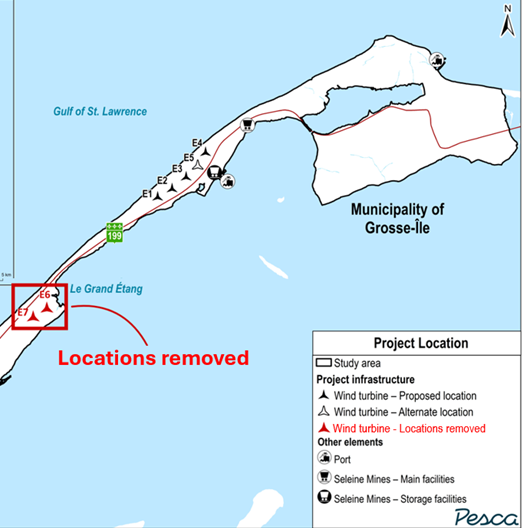
Îles‑de‑la‑Madeleine, April 23, 2026 – Following ongoing discussions with host community stakeholders and organizations, recent public hearings held by the Bureau d’audiences publiques sur l’environnement (BAPE), and exchanges with Québec’s Minister of the Environment, the Fight Against Climate Change, Wildlife and Parks, Nutrinor–Gilbert Énergies renouvelables and l’Alliance de l’énergie de l’Est have jointly committed to removing two wind turbine locations from the Grosse-Île Wind Farm project in the Magdalen Islands. The two turbines locations initially planned for the southernmost sector of the site, on the lagoon side near Grand Étang (locations E6 and E7), will be withdrawn. This decision reflects the importance of protecting sensitive ecosystems and wetlands, preserving Conrad’s crowberry shrub habitats, considering the presence of potential habitats for the Horned Grebe, as well as addressing concerns raised by community members and environmental organizations.
“From the outset, our objectives have remained the same: to maximize positive benefits for the community while responding to local concerns related to renewable energy development and environmental impacts, all while meeting Hydro‑Québec’s contractual requirements. We are fully committed to a constructive, rigorous, and responsible process to develop a project that will be considered acceptable over the long term, economically, energetically, environmentally, and socially, by taking community input into account,” said Maxime Gilbert, general manager of Nutrinor‑Gilbert Énergies renouvelables.
Listening to concerns and adapting the project
Environmental organizations and local residents expressed concerns regarding the location of the two turbines initially planned for the southern lagoon-side sector, as well as the potential dispersion of the project across two sites.
“We continued our technical and environmental analyses in collaboration with the Minister of the Environment to optimize and reassess the turbine locations for the Grosse-Île Wind Farm, while carefully listening to the interventions of the citizens of the Magdalen Islands and organizations. These adjustments reflect the changes made and our genuine desire to design the best possible project. We remain committed to ongoing dialogue with the community,” added Simon Deschênes, vice president, Alliance de l’énergie de l’Est.
From the initial scenario to a reduced environmental footprint
The selection of turbine locations for this project is the result of more than 20 years of consultation efforts conducted in the Magdalen Islands. The site was identified and retained following rigorous analyses and consultations based on technical, environmental, and community integration criteria.
An environmental impact assessment was conducted using a maximum scenario of seven turbines. This approach made it possible to evaluate potential environmental effects comprehensively while maintaining flexibility in the final selection of turbine locations and models. The initial scenario included four proposed sites and three reserve sites, distributed across the northern (Gulf side) and southern (lagoon side) sectors.
With the removal of the two southern lagoon-side turbine locations near Grand Étang, the project confirms its intention to develop four wind turbines comparable in scale to those at the North Dune Wind Farm, located near the Mines Seleine port facilities and the Minister of Transport and Sustainable Mobility’s sand depot. This adjusted configuration is consistent with the project’s original objectives: delivering tangible benefits to the community, minimizing environmental impacts, and continuing to respond to stakeholder concerns.
Significant positive impacts
The Grosse-Île Wind Farm project fully aligns with Hydro‑Québec’s decarbonization action plan. It contributes directly to the energy transition while limiting its ecological footprint. The project would generate 16.8 megawatts (MW) of renewable energy for the local grid and allow 40% of the Islands’ electricity to come from renewable sources.
It would also help avoid the emission of approximately 30,000 tonnes of greenhouse gases per year on the Islands’ electricity network and reduce annual fuel oil consumption at the thermal power plant by 11 million litres.
— 30 —
Media Contacts :
| Simon Falardeau, PRP, ARP
Nutrinor‑Gilbert Énergies renouvelables 514 755-5831 |
Lou Landry
Alliance de l’énergie de l’Est 581 886-3424 |